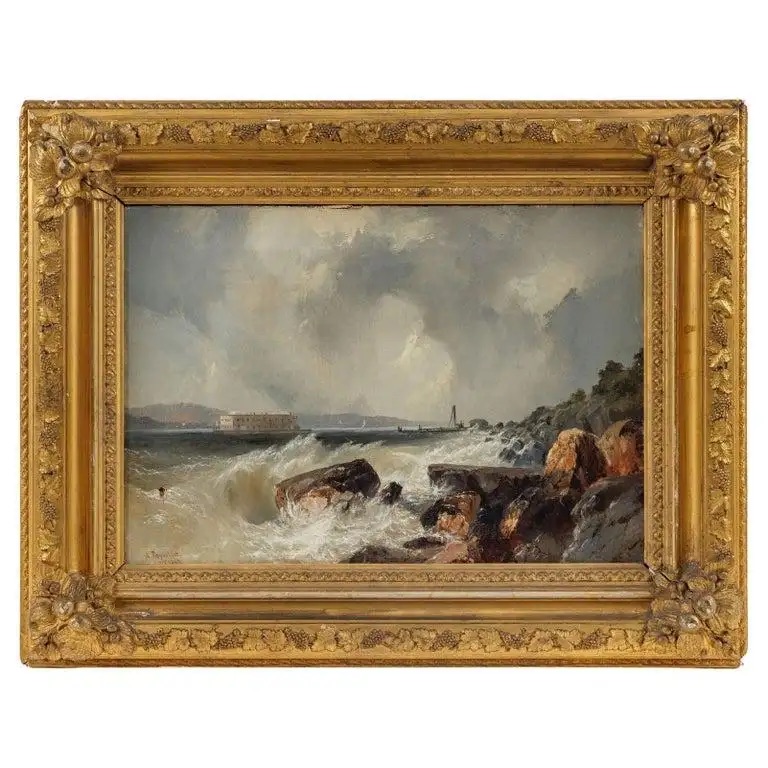
Alfred Copestick, Fort Hamilton from the Narrows, New York, 1857
$ 92.71
Alfred Copestick, Coastal Scene: New York, Oil on Canvas, 1857 1857 CFort Hamilton from the Narrows, New York, 1857 Oil on canvas, in the original giltwood frame 14 ¼ x 20 ⅛ in. (canvas) Signed lower right: A. Copestick NY 1857 Painted when Copestick was only twenty years old, Fort Hamilton from the Narrows, New York captures both the military fortifications and maritime vitality of New York Harbor at mid-century. In the foreground, the fortress bastion commands the shoreline, while sail and steam vessels traverse the Narrows — the strategic waterway linking Upper New York Bay to the Atlantic. Copestick conveys not only the architectural solidity of Fort Hamilton but also the shifting atmosphere above, where cloud formations build and dissolve across a wind-driven sky. The painting is a remarkable marriage of documentary precision and romantic sensibility. The young artist’s brush imbues the fortress with weight and presence, yet the broader scene is alive with the transience of weather and the ceaseless motion of the sea. In its original giltwood frame, richly carved and preserving the period character, the canvas is a rare survival of a gifted hand cut short in its prime. This canvas reveals Copestick’s deep engagement with the maritime traditions of American art. The careful delineation of sailing vessels recalls the precision of James E. Buttersworth, while the atmospheric breadth echoes the influence of Fitz Henry Lane and John F. Kensett. The choice of subject — the strategic Narrows and its fortress — also reflects the national mood of the 1850s, when American identity was bound up with its coasts, harbors, and defenses. The romantic skies and dramatic contrasts suggest the impact of the Hudson River School, particularly the legacy of Thomas Cole and Asher B. Durand, whose landscapes balanced grandeur and naturalism. Like his contemporaries, Copestick sought to capture the sublime in nature, but his unique contribution was to anchor that vision in New York’s maritime heart. Born in New York in 1837, Alfred Copestick came to prominence in his late teens, producing ambitious coastal canvases that quickly drew critical attention. In 1857 he completed both Coastal Scene: New York and Fort Hamilton from the Narrows, New York, works that stand today as rare testaments to his emerging style. In 1858 he painted his most celebrated canvas, New York from the Harbor Showing the Battery and Castle Garden, now in the Metropolitan Museum of Art, New York. Copestick exhibited marine subjects at the National Academy of Design, where critics praised him as “a young man of rare promise.” Yet in August 1859 his career ended abruptly when he suffered a fatal accident in Delmar Township, Pennsylvania, where a hunting rifle discharged while he was visiting his father. At just twenty-two, his life and career were tragically cut short, leaving behind only a handful of surviving works. Institutional References: The Metropolitan Museum of Art, New York – New York from the Harbor Showing the Battery and Castle Garden (1858), oil on canvas, acc. no. 54.90.89. National Academy of Design, New York – Exhibited marine works by Copestick in the late 1850s. Other works known through exhibition records or gallery inventories include Coney Island, New York (1857) and Coastal Scene, New York (1857) – which we are also currently offering for sale – both formerly with Alexander Gallery. Fort Hamilton from the Narrows, New York stands as one of Alfred Copestick’s most significant early works. It documents a crucial site in New York’s maritime and military history while at the same time revealing the hand of a painter intent on capturing the sublime. The balance of fortress, sea, and sky underscores Copestick’s ability to imbue topographical subjects with romantic vitality. This painting represents both a rare market opportunity and a museum-worthy addition to any serious collection of American nineteenth-century painting. In tandem with his Coastal Scene and the harbor view in the Met, it helps complete the short but compelling narrative of a prodigy who, despite his untimely death, left behind works of enduring resonance. Provenance: Alexander Gallery, Madison Avenue, New York Canvas: 14 ¼ x 20 ⅛ in. Frame: 22″ high x 28″ wide Very good condition. Ready to hang. Period:19th CenturyMovement & Style::AcademicWidth:28 in (71.12 cm)Height:22 in (55.88 cm)Creator:Alfred Copestick (1837 – 1859, American)Date of Manufacture:C. 1857Materials & Techniques:Alfred Copestick (1837 – 1859, American)